Continuing education requirements for school psychologists vary across states. For example, North Carolina requires 8 CEUs (80 clock hours) every five years for student services personnel, while NCSP renewal involves 75 CPD hours over three years including specific content and approved provider criteria.
Why do state CE requirements differ from NCSP renewal?
State education agencies set their own continuing education rules for school psychology credentials. The NCSP renewal follows a distinct national standard.
The National Association of School Psychologists (NASP) sets school psychologist continuing education requirements at 75 CPD hours per three-year cycle. Of these, at least 10 hours must be from NASP-approved or APA-approved providers, including minimums of 3 hours in ethical practice or legal regulation and 3 hours focused on equity, diversity, inclusion, and social justice. Meanwhile, states specify their own hour counts, course categories, and documentation. If you hold both credentials, you’ll manage two separate compliance systems.
How is the NCSP renewal standard different from state mandates?
The NCSP renewal allows qualifying asynchronous online courses to count toward Category H: Formal Self-Study, up to 40 CPD hours per cycle. Live online sessions count as Category A with no maximum. State boards often have more conservative limits on online learning or self-study hours.
Does holding the NCSP fulfill state credentialing requirements?
Some states accept the NCSP as an alternative path to school psychologist credentialing, while others require separate documentation aligned with their rules. You should check with your state’s education department to confirm acceptance before relying on reciprocity.
Requirements depend on where you practice. Our 50-state guide helps clarify which states accept NCSP hours and which require separate documentation. Planning your development involves keeping track of both NASP’s 75-hour cycle and your state’s requirements. Meeting both ensures your credentials stay current.
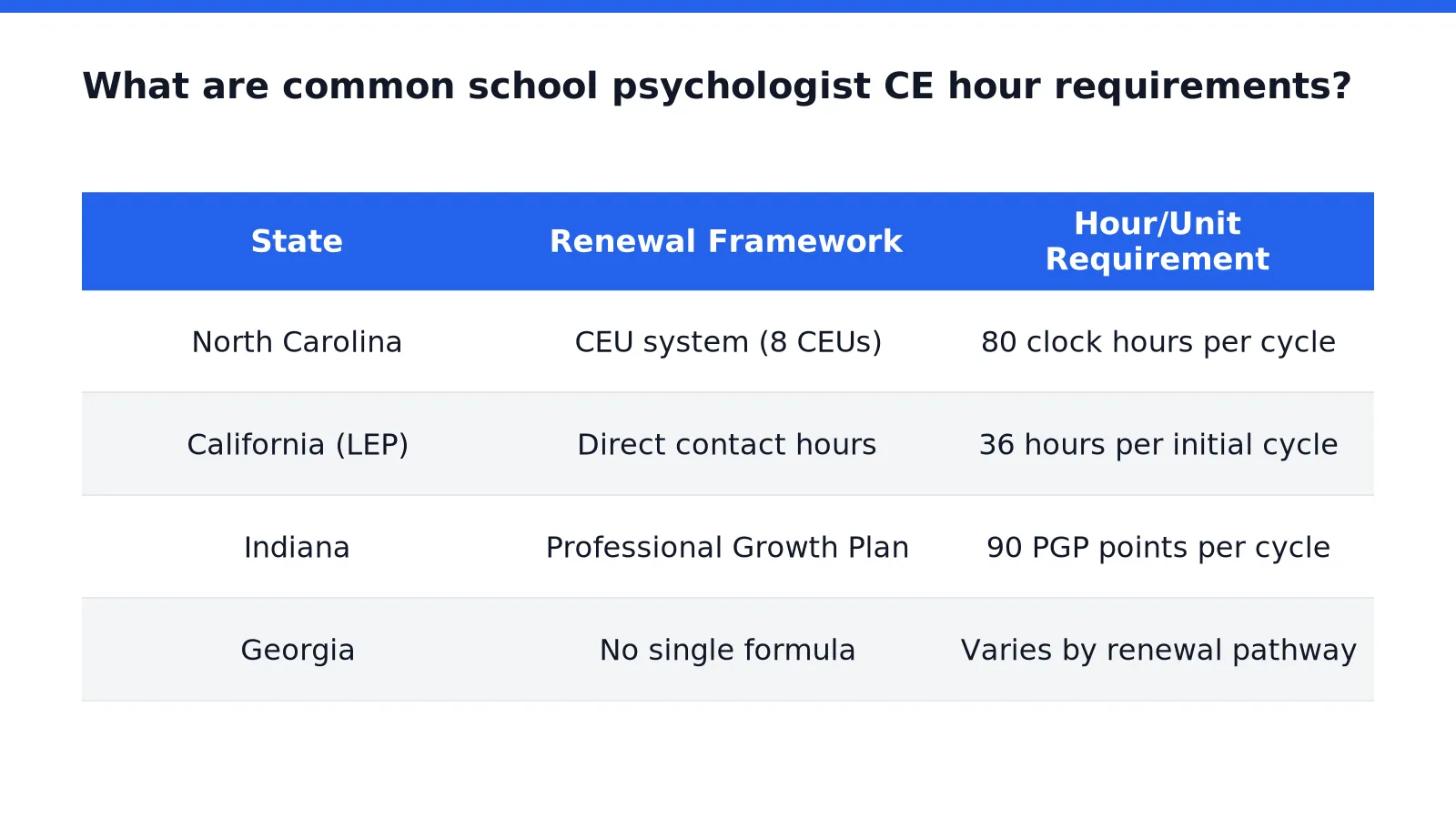
What are common CE hour requirements for school psychologists?
Continuing education requirements vary across states, with different systems in place. Some follow traditional credit-hour models, others use points-based professional growth plans. Understanding your state’s structure helps you keep your credentials current without unnecessary pressure.
How do state credit and points systems work?
States vary widely. North Carolina uses a CEU system where 8 CEUs equal 80 clock hours over five years for renewal of student services licenses.
California Licensed Educational Psychologists complete 36 continuing education hours every two years, plus a one-time 3-hour telehealth training.
Indiana employs a 90-point Professional Growth Plan over five- or ten-year renewal cycles, equating one hour of professional development to one point.
Are CE requirements always fixed hours?
Not always. For example, Georgia doesn’t enforce a specific CE-hour formula for renewal. Instead, school psychologists verify acceptable activities and documentation directly with the Georgia Professional Standards Commission, allowing some flexibility in how you meet requirements.
Here’s a quick comparison:
Because requirements differ, courses accepted in one state might not count in another. Your best approach is to match courses to the requirements of the credential you hold and the renewal cycle you’re in.

How do renewal cycles vary by state?
Renewal terms range from two to ten years depending on the state. For example, California renews every two years, while some Indiana licenses renew every ten years. Knowing your cycle helps plan your continuing education activities comfortably without pressure near deadlines.
Which states use a five-year renewal cycle?
North Carolina and Georgia both generally use five-year renewal terms. This is a common renewal period for many states.
Do some states offer longer license terms?
Indiana offers a 10-year Accomplished Practitioner License option alongside a 5-year Practitioner License, providing flexibility based on your career stage, with corresponding continuing education requirements.
How does cycle length influence CE planning?
Longer renewal cycles mean you’ll accumulate more required hours over time, which can offer flexibility in scheduling your coursework. Shorter cycles spread those hours out more frequently. Tailor your development plan to fit your license’s specific timeframe and state guidelines.
What types of CE activities count for school psychologists?

You can satisfy your continuing education requirements through formal coursework, self-study programs, and state-mandated trainings. Accepted activities differ depending on your credential — NCSP, state license, or certificate — each with its own documentation rules.
What counts toward NCSP renewal?
NCSP renewal requires 75 CPD hours every three years, including at least 10 from NASP- or APA-approved providers; 3 hours in ethics/legal regulation; and 3 hours in equity, diversity, inclusion, and social justice. Up to 40 hours of qualifying asynchronous online courses may count toward Category H: Formal Self-Study, while live online sessions count as Category A without limitation. If you prefer self-paced learning, ensure your provider is NASP-approved before enrolling. The NCSP continuing professional development requirements outline full details.
Do state certificates require other activities?
Yes. For example, Indiana requires current CPR/AED certification from an approved provider and training on child abuse and neglect along with coursework hours.
Georgia accepts a valid NCSP or State of Georgia psychologist license to satisfy School Psychology certificate renewal, meaning no extra coursework is needed beyond holding either credential.
What about one-time state mandates?
California asks Licensed Educational Psychologists to complete a one-time 3-hour telehealth training alongside their regular continuing education hours; this is a distinct requirement to keep in mind.
Your continuing education includes formal CPD courses, state-specific certifications like CPR, and one-time trainings required by law. Here’s an overview:
Since requirements vary by credential and state, it’s helpful to track each separately to ensure you meet all your obligations.
How can I verify my state’s specific CE requirements?
Each state sets its own continuing education rules. To keep your renewal on track, familiarize yourself with your state board’s guidelines and stay organized.
What official sources confirm my state’s CE obligations?
Your state department of education has the most current and authoritative requirements. NASP’s State School Psychology Credentialing Requirements list collects this information in one place. To be sure, consider contacting your state licensing board directly to confirm any recent updates.
Note that licensing categories may vary. For instance, North Carolina classifies school psychologists under student services licensure, so renewal info is grouped there rather than under a psychology-specific heading. Make sure to check all relevant categories.
Do renewal pathways vary within a single state?
Yes, states like Georgia offer multiple renewal options. You may renew through general state requirements or via school psychology-specific alternatives such as holding a current NCSP or Georgia psychologist license. Exploring available pathways can help you select the most convenient option.
Also, school psychologist requirements often differ from those for licensed psychologists renewing through health boards. Confirming the correct regulatory body helps you focus your efforts appropriately.
Where can I find helpful summaries on state requirements?
Child & School Psychology CE offers clear, concise summaries for each state that translate regulatory language into practical checklists. The platform provides NASP-approved professional development tailored to school psychologists and related professionals.
Cross-referencing multiple sources—state board sites, NASP lists, and summary pages—provides a complete picture and reduces confusion.
What should I look for when choosing CE providers?
When selecting a continuing education provider, consider three key factors: recognized approval status, relevance to school psychology, and clear credit information. Choosing a provider that meets these will support smooth license renewal and avoid time spent on credits that don’t count for your credential.
Is the provider recognized for school psychologist CE?
Provider approval is essential because boards only accept credits from approved sources. If you hold the NCSP credential, look for NASP-approved providers to ensure courses meet professional standards. Child & School Psychology CE is a NASP-approved provider offering courses tailored for your needs.
State boards have different approval systems. For example, California’s Board of Behavioral Sciences recognizes specific agencies for approving CE providers and courses. Checking approval status before enrolling helps avoid surprises later.
How can I confirm that coursework fits my renewal cycle?
Your CE credits should align with both your credential type and renewal period. For NCSPs, that’s 75 CPD hours over three years with clear categories; for state licenses, requirements differ. Providers should specify whether courses meet NCSP category criteria or state mandates. If there’s uncertainty, seek clarification before enrolling.
Remember, courses approved for APA credit might not fulfill NASP or state education department standards. Check provider catalogs carefully so you don’t have to dig through regulations on your own.
What course quality and format features matter?
Quality matters. NASP-approved home study courses designed for school psychologists focus on practical, research-based content you can apply in your work. Look for courses with clear objectives, interactive elements, and completion records, rather than passive videos with little engagement.
Online courses add flexibility, letting you learn on your schedule. Choose providers committed to delivering engaging and relevant training to make the most of your time.
Will the provider keep up with changing state requirements?
Regulations can shift, as seen when California updated its CE program in 2015. Providers who monitor such changes and update their offerings accordingly can help you stay current with less effort.
Providers focusing on school psychology generally maintain knowledge of NASP standards and state frameworks. This attention shows in courses that clearly reference applicable rules and credit types. Broad mental health providers may not offer this level of targeted guidance.
How do I track and document my CE hours properly?
Keeping accurate records is important to ensure smooth renewal. Documentation formats and requirements differ by state.
What format does my state require for documenting CE?
Indiana requires a Professional Growth Plan serving as a centralized record of your continuing education activities.
North Carolina’s system tracks 8 CEUs per five-year renewal, with each CEU equaling 10 clock hours. You’ll want to keep documentation connecting your activities to this clock hour total.
Georgia uses Professional Learning Units. If not employed by a local unit at renewal, 10 PLUs from the Georgia Association of School Psychologists can meet requirements, with documentation verifying the awarding organization and unit count.
How do I confirm my CE activities will be accepted?
Check before you start. Review your state’s published guidelines, verify provider approval with your state board, and keep documentation showing both approval and completion.
Courses accepted in one state may not qualify in another, so aligning your activities with your specific state’s framework is the safest approach. Documentation should clearly show how each activity relates to your professional role. Certificates should include the provider name, course title, date, and hours earned to avoid any confusion.
At Child & School Psychology CE, completion certificates are designed with these elements included, making it easier for you to meet your documentation needs.
Where can I find NASP-approved CE courses for my state?
Platforms designed for school psychologists, like Child & School Psychology CE, provide NASP-approved home study programs tailored to your licensure needs. These courses focus on practical, evidence-based content developed with busy professionals in mind.
The catalog covers key areas of practice such as assessment, intervention, consultation, and ethics that align with educational and professional standards across multiple states.
What makes a CE course count toward my state’s renewal?
Each state determines which NASP-approved activities qualify for its renewal process. Our website includes state-specific pages that outline these rules, helping you identify which courses will support your license renewal.
How do online courses fit into your professional development?
Online delivery makes it easier to fit training into your busy days. Our courses allow you to progress at your own pace, balancing clinical duties and family commitments while engaging with meaningful, graduate-level content.
We design our programs to bridge research and practice, offering strategies you can immediately apply when consulting, assessing, or intervening in school settings while earning necessary credits.
Conclusion
By matching your continuing education activities to your state’s documentation needs and confirming provider approval ahead of time, you can approach renewal with confidence and ease. Selecting NASP-approved courses tailored to your state’s requirements ensures your effort is well invested, avoiding last-minute surprises.
Since rules can change, be sure to verify current requirements with your state board and NASP to keep your credentials in good standing.