

Classroom accommodations succeed when treatment plans include the school environment, a principle reflected in national pediatric clinical guidance. Child & School Psychology Continuing Education offers NASP-approved, evidence-based home study courses equipping school psychologists to design practical, research-backed ADHD evaluations and accommodations for K-12 students. teacher delivered behavior supports in K-5 classrooms.
Evidence-based ADHD evaluation for school psychologists combines multidisciplinary data collection with AAP-recommended school-based treatment planning, integrating classroom observations, teacher and parent rating scales, and academic records. Child & School Psychology Continuing Education delivers NASP-approved coursework covering diagnostic criteria. Accommodation design, equipping evaluation teams and NCSPs to translate ADHD assessment findings into practical, legally defensible classroom supports.
What Will You Accomplish and What Do You Need First?
School psychology teams accomplish two things through structured ADHD training: sharper diagnostic accuracy and a clear accommodation-planning process that holds up under IDEA scrutiny. Children with attention-deficit/hyperactivity disorder face more academic and behavioral obstacles than their peers. Evaluation teams need a repeatable protocol rather than ad hoc judgment calls. Without that structure, referral backlogs grow and eligibility decisions become inconsistent across a district.
Before diving into assessment tools, evaluators need a foundation. Three prerequisites matter most:
- Familiarity with current diagnostic criteria and how symptoms present differently across age groups and settings.
- Working knowledge of eligibility categories under IDEA, particularly how ADHD qualifies a student under Other Health Impairment ADHD IDEA criteria.
- A plan for coordinating with parents, classroom teachers, and administrators, since children with ADHD succeed in school only when those parties work together rather than in isolation.
What Does an ADHD Evaluation Training Program Actually Cover?
A well-designed child ADHD evaluation training program walks practitioners through rating scale selection, classroom observation methods, and differential diagnosis considerations. It also builds skill in translating assessment data into accommodation recommendations that hold up at an IEP or 504 meeting. NASP-approved home study programs give evaluators a structured way to build or refresh these competencies before accepting new referrals, letting them study around district schedules instead of pausing casework.
Who Needs to Be Involved Before Evaluation Begins?
No evaluator works alone on a strong outcome. Parents provide developmental history, teachers supply classroom observation data, and administrators confirm which services and supports the district can implement. Establishing this network early prevents delays once school psychologist ADHD interventions move from recommendation to implementation. It keeps the eventual accommodation plan grounded in real classroom conditions rather than assumptions.
How Do You Confirm a Referral Warrants a Full Evaluation?
Confirming a referral starts with matching the presenting concern against documented patterns of attention or behavior difficulty. Attention problems rank among the most frequent reasons students land on a school psychologist’s referral list in the first place, according to Evidence Based Practices in School Mental Health: ADHD. That frequency means evaluation teams need a consistent process, not a case-by-case guess, to separate a genuine evaluation candidate from a temporary classroom disruption.
What Signs Should Trigger a Closer Look?
Impulsivity markers give evaluators an early, observable clue. A student who blurts out answers before a question is finished, as noted in Evidence Based Practices in School Mental Health: ADHD, often signals a pattern worth tracking rather than a one-time lapse. Teams should log frequency, setting, and duration before deciding whether the pattern rises to referral status.
A practical intake sequence helps standardize that decision:
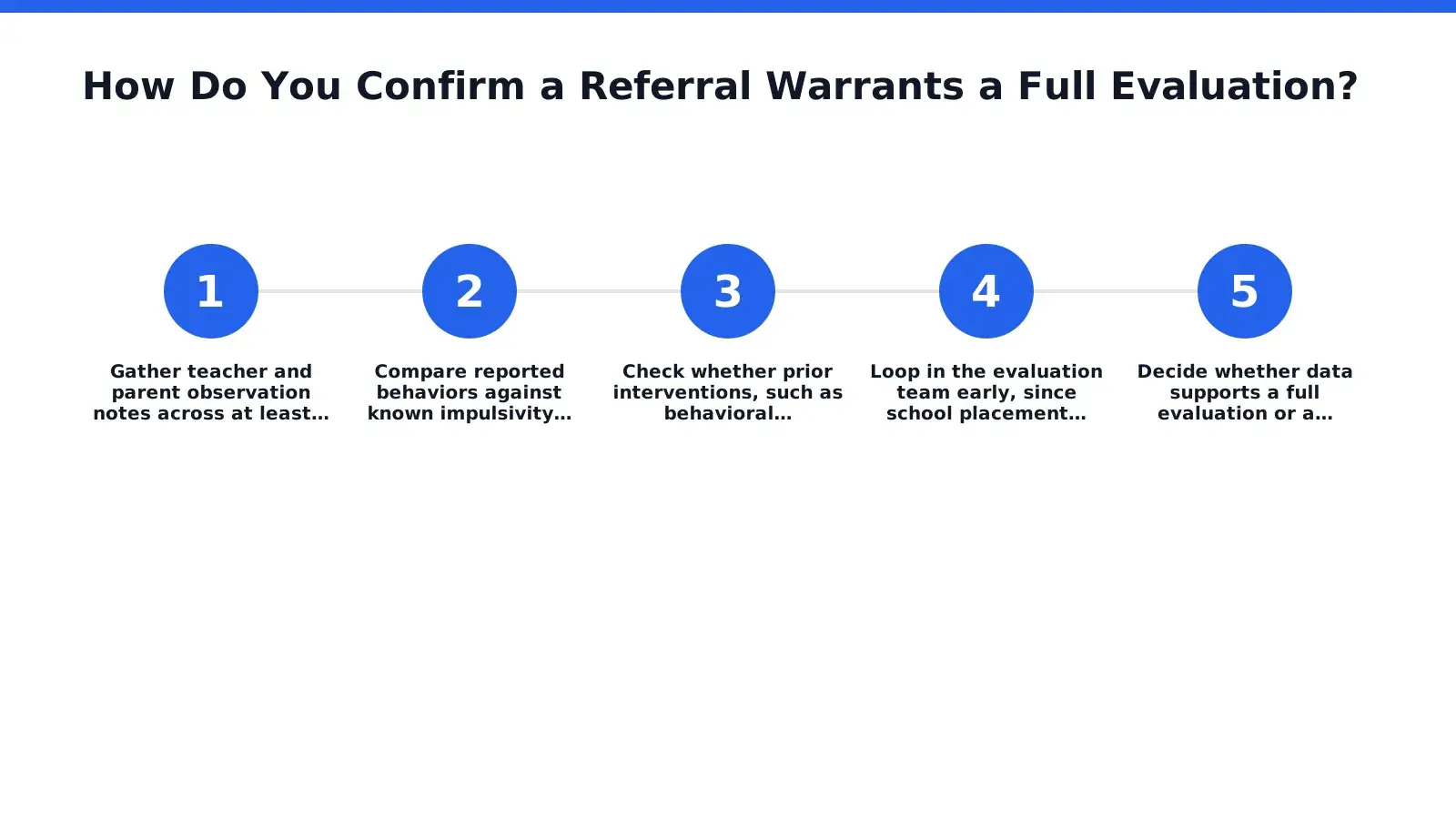
- Gather teacher and parent observation notes across at least two settings.
- Compare reported behaviors against known impulsivity and attention indicators.
- Check whether prior interventions, such as behavioral classroom management, were attempted and documented.
- Loop in the evaluation team early, since school placement and program design factor directly into treatment planning.
- Decide whether data supports a full evaluation or a shorter monitoring period.
Why Involve the School Team So Early?
The American Academy of Pediatrics treats the school environment as a core piece of any ADHD treatment plan, not an afterthought. That guidance supports pulling the evaluation team into the conversation as soon as a pattern emerges, rather than waiting until concerns escalate. Early involvement keeps data collection consistent and avoids gaps that complicate later eligibility decisions.
Sound judgment at this intake stage rarely comes from instinct alone. Courses built on research-based readings, paired with activities and assessments, sharpen the fine-grained calls evaluators must make when a referral sits on the borderline. Child ADHD evaluation training grounded in that format gives evaluation teams a repeatable framework instead of a subjective guess.

How Do You Gather Multi-Source Assessment Data?
Multi-source assessment data comes from four channels: school records, teacher report, direct rating scales, and classroom observation. Evaluation teams combine these streams rather than relying on a single informant. A complete record follows a defined sequence.
- Review existing school supports first. Schools may already offer ADHD treatments, special education services, or classroom accommodations before a formal referral begins. Cataloging these supports gives evaluators a baseline of what interventions the student has already experienced.
- Collect teacher-report data as a required component. Teacher-administered behavior therapy is a recommended treatment element for school-age children with ADHD, so teacher observations carry evaluative weight, not just instructional value. Skipping this step leaves a gap no parent questionnaire can fill.
- Score standardized rating scales for concrete behaviors. Items describing frequent difficulty waiting for a turn translate abstract concerns into documented, countable evidence. These scores anchor clinical judgment to observable classroom conduct rather than impression alone.
- Pair rating data with direct classroom observation. Watching the same behaviors rating scales flagged confirms patterns across settings and reduces reliance on any single reporter’s perspective.
Why does teacher input matter more than a single classroom observation?
Teachers see the student across hundreds of instructional hours, not one sampled period. Because behavior therapy delivered by teachers is a recommended treatment component, their reports double as both assessment data and a record of intervention response.
What if school records show no prior interventions?
Absence of prior supports does not stop the evaluation. It simply narrows the record-review step and shifts more weight onto rating scales and direct observation.
Sound school psychologist ADHD interventions planning depends on this layered approach. NASP-approved continuing professional development built specifically for school psychologists reinforces the multi-informant methods this stage requires.
How Do You Apply Diagnostic Criteria and Rule Out Alternatives?
School evaluation teams apply diagnostic criteria by cross-checking observed behaviors against established symptom clusters, then testing each behavior against competing explanations. The American Academy of Pediatrics’ clinical practice guideline identifies ADHD as the most common neurodevelopmental condition evaluators encounter, which is exactly why differential diagnosis carries so much weight. A quick behavior checklist rarely settles the question on its own.
Consider a student who often interrupts or intrudes on others during class discussions, a frequent reason for referral to a school psychologist. That pattern fits an impulsivity marker under standard criteria. But the same behavior shows up in students managing anxiety or reacting to trauma. Evaluation teams must weigh timing, triggers, and consistency across settings before attaching a diagnostic label.
What steps help distinguish ADHD from other conditions?
- Gather behavior data across multiple settings, not just one classroom or one observer.
- Compare symptom onset and duration against anxiety, mood, or trauma-related presentations.
- Separate treatment planning from diagnosis; behavioral classroom management and organizational training are ADHD treatments, not diagnostic tools themselves.
- Document functional impact on academic performance, since criteria alone don’t establish eligibility.
Why does training matter for this process?
Differential diagnosis demands more than symptom-spotting; it requires structured judgment built through practice. Customized, evidence-based training designed for professionals working with children, schools, and families strengthens that judgment directly. Evaluation teams who pursue child ADHD evaluation training build sharper skills for separating true ADHD presentations from anxiety, trauma, or other overlapping conditions, reducing misidentification risk before it reaches an IEP table.
How Do You Determine Eligibility Under Other Health Impairment?
Eligibility under Other Health Impairment ADHD IDEA criteria rests on documented evidence that ADHD limits a student’s alertness or access to the educational environment. Evaluation teams confirm the diagnosis, then connect that diagnosis to functional impact in the classroom. A confirmed diagnosis must be linked to how symptoms interfere with learning for eligibility under OHI.
Special education services stand as one of the accepted school-based responses once a diagnosis is confirmed. They form the foundation of an OHI eligibility finding. Evaluation teams typically document this through a structured sequence.
- Gather diagnostic documentation confirming ADHD from a qualified provider.
- Collect classroom observation data showing attention, activity, or impulsivity concerns across settings.
- Determine whether symptoms limit alertness to educational tasks, a core OHI requirement.
- Identify accommodations designed to lessen the effect of ADHD on learning, since this reduction in impact is the standard evaluation teams describe in eligibility statements.
- Write the eligibility statement linking diagnosis, observed impact, and proposed supports.
What documentation strengthens an OHI eligibility statement?
Strong statements pair diagnostic paperwork with classroom-based evidence, not just a physician’s letter. Teams describe specific tasks affected, such as sustaining attention during independent work or managing multi-step directions.
Why does state variation matter for evaluation teams?
CE requirements and eligibility procedures differ from state to state, which complicates consistent OHI documentation across districts. Coursework built to meet requirements for NCSPs, LEPs, and school psychologists in multiple states helps evaluation teams stay current on shifting standards. Child ADHD evaluation training grounded in practical, evidence-based methods supports accurate, defensible documentation. Affordably priced coursework lets teams strengthen school psychologist ADHD interventions. Refine their ADHD assessment in schools guide practices without pressuring already tight professional-development budgets.
How Do You Design Evidence-Based Classroom Accommodations?
Evidence-based classroom accommodations start with matching a specific support to a specific barrier, not applying a generic checklist across every student with ADHD. School psychologists, LEPs, and evaluation teams build these plans from three core supports, each targeting a distinct challenge in the school day. Effective plans function as a custom toolkit built around how an individual student learns, rather than a uniform template handed to every case.
Extended time on assignments and tests offers one of the clearest examples. This accommodation functions as a buffer, easing the pressure of a ticking clock for students who struggle with processing speed or sustained focus. Evaluation teams weighing this support should document specific tasks where time pressure produces errors unrelated to content mastery, such as rushed math computation or incomplete essay responses.
Behavior cues serve a different purpose. They act as a redirect system, gently pulling wandering attention back to task without singling a student out in front of classmates. A teacher tap on the desk or a quiet visual signal works far better than public correction, which often increases anxiety and disengagement.
Assistive technology rounds out the toolkit. Tools like speech-to-text software and digital timers become dependable, everyday learning supports rather than occasional accommodations pulled out for testing days only.
What order should teams follow when building the plan?
- Identify the specific barrier: attention drift, processing speed, or written output.
- Match one accommodation type to that barrier using the categories above.
- Pilot the support for a defined period and collect classroom data.
- Revise based on teacher and student feedback before finalizing the IEP language.
Should every student receive the same combination?
No single combination fits every case. Teams should treat the toolkit as adjustable, selecting only the supports that address a documented, individual barrier.
How Do You Monitor Progress and Adjust the Plan?
Progress monitoring requires evaluation teams to track two distinct accommodation categories, not one blended outcome. Some supports lower anxiety around timed tasks; others quietly reinforce sustained focus. Treating these as separate data streams gives a clearer picture of what each intervention actually changes.
Follow these steps when reviewing an accommodation plan:
- Separate anxiety-reduction supports (extended time, reduced-pressure testing formats) from focus-reinforcement tools (behavior cues, assistive technology) in the data collection sheet.
- Record classroom observations weekly, noting which category shows measurable change.
- Compare findings at each scheduled review meeting rather than waiting for annual reevaluation.
- Adjust only the underperforming category first, keeping working accommodations stable.
- Document each small win, since a single extended-time success or a reduced outburst counts as trackable progress toward a larger pattern.
Applied correctly, small adjustments compound. A frustrating school day becomes a string of measurable wins that teams can point to at review meetings, rather than a vague impression of “doing better.” Consistent tracking over multiple review cycles lays the groundwork for lasting student confidence and stronger academic outcomes, not just short-term compliance with the plan on paper.
How Often Should Teams Reassess Accommodations?
Review meetings should happen more frequently than the standard annual IEP cycle when a student’s data shows conflicting trends between anxiety and focus measures. Quarterly check-ins catch drift before it becomes a pattern requiring a formal plan rewrite. Waiting a full year risks letting an ineffective accommodation sit unchanged.
Where Can Evaluators Refresh Their Monitoring Skills?
Busy caseloads leave little room for lengthy workshops between reviews. Self-paced, NASP-approved coursework built for school psychologist ADHD interventions lets evaluators revisit monitoring methods on their own schedule, fitting professional development around, not against, a full evaluation caseload.
What Mistakes Should You Avoid During Follow-Up?
Follow-up fails most often when evaluation teams treat the written plan as the finish line. Outcomes improve when parents, teachers, and administrators stay engaged well after the paperwork is signed. Children with ADHD succeed in school when these groups keep working together, not just during the initial assessment window.
A related error involves separating the classroom from the rest of the treatment picture. The American Academy of Pediatrics recommends that school placement. Programming remain part of any ADHD treatment plan, not a side note attached after clinical decisions are made. When school psychologists, LEPs, and NCSPs build accommodations without looping in the treating clinician, the plan risks becoming disconnected from the child’s broader care.
Why Does Team Communication Break Down After the IEP Meeting?
Communication often stalls because no one owns the follow-through once the meeting ends. Teachers may not know which accommodations require daily tracking, and administrators can lose sight of review dates. Evaluation teams avoid this by assigning a single point of contact for ongoing updates between home, classroom, and clinical providers.
Common follow-up mistakes include:
- Closing the file after the eligibility meeting instead of scheduling a review
- Leaving the school environment out of the child’s overall treatment plan
- Assuming teacher observations are optional once accommodations start
- Letting professional development lapse instead of renewing it early
Should Recertification Wait Until the Deadline Approaches?
Waiting rarely works out well. Courses built around the demanding schedules of practicing school psychologists exist precisely so recertification doesn’t become a last-minute scramble. Child ADHD evaluation training delivered through NASP-approved, self-paced online coursework lets evaluation teams renew credentials steadily, rather than compressing hours into a single stressful month before a license lapses.
Conclusion
In closing, mastering evidence-based ADHD evaluation and classroom accommodations represents a cornerstone competency for school psychologists committed to meaningful student outcomes. The intersection of rigorous assessment practices and thoughtful instructional supports transforms how we serve children with ADHD, equipping educators and mental health professionals with the knowledge and skills necessary to make informed, impactful decisions in their daily practice. By grounding your work in research-based approaches and staying current with best practices, you strengthen your ability to advocate effectively for students while contributing to more equitable, supportive school environments.