
School psychologists can access NASP-approved, evidence-based ASD assessment training through Child & School Psychology Continuing Education, which combines research-based readings with interactive activities. Self-paced online modules fit demanding schedules while satisfying NCSP. State licensure requirements, equipping professionals with practical diagnostic skills for accurate, comprehensive autism evaluations in K-12 settings.
School psychologists face a doubling in the number of children identified with autism over the past decade, demanding evidence-based assessment skills. NASP-approved courses build practical, self-paced competence in screening, evaluation, and educational planning for ASD, equipping professionals to meet this growing demand confidently. School based CBT for school psychologists
Autism spectrum disorder assessment in schools demands structured training, since diagnosed cases have more than doubled over the past decade. Child & School Psychology Continuing Education delivers NASP-approved, reading-based courses with interactive scenarios and School-Based CBT for School Psychologists: Anxiety & ADHD, equipping school psychologists. LEPs with evidence-based screening, assessment, and educational-planning skills for ASD identification, at a self-directed pace.
Why Is ASD Assessment in Schools So Challenging Now?
The number of children identified with autism has more than doubled over the last decade, fundamentally changing what school psychologists face in their daily caseloads. This surge creates a situation where demand for school-based autism identification outpaces the training many professionals originally received.
School-based professionals are now asked to participate in screening, assessment, and educational planning for children on the spectrum more than at any other time in the recent past. The call for greater use of evidence-based practice has increased demands that school personnel be prepared to recognize the presence of risk factors, engage in case finding, and be knowledgeable about best practice guidelines. Without targeted ASD assessment training, school psychologists may feel underprepared for expanded responsibilities.
What specific skills do school psychologists need now?
An autism diagnostic evaluation in schools requires a different skill set than what many practitioners learned during graduate programs. School psychologists now need fluency with DSM-5 diagnostic criteria, familiarity with updated assessment tools, and the ability to distinguish autism from overlapping conditions such as anxiety or language disorders. These skills are not optional; missing a diagnosis delays intervention by years.
How can a school psychologist assessment guide help?
A structured school psychologist autism assessment guide offers a roadmap through the complexities of differential diagnosis, case conceptualization, and evidence-based intervention planning. Such a guide helps practitioners organize the assessment process from initial case finding through final recommendations.
Child & School Psychology Continuing Education provides NASP-approved continuing professional development specifically designed for school psychologists and other child-focused professionals. These courses offer practical training on current best practice guidelines, helping professionals build the assessment skills that the present moment demands.

What Do You Need Before Starting an ASD Evaluation?
A school psychologist beginning an ASD assessment training school psychologists must first secure a practical, scientifically-based framework. This framework should integrate current research evidence with theory and best-practice for identifying, assessing, and treating children with autism spectrum disorder in school settings. The approach must be fully updated to reflect DSM-5 and current assessment tools, procedures, and research.
Prerequisites for a School-Based ASD Evaluation
Before conducting an autism diagnostic evaluation in schools, a practitioner needs several foundational elements in place. These ensure the process is both valid and legally defensible.
- Updated Knowledge Base: The evaluator must understand DSM-5 criteria and how they apply to school-age children. This includes familiarity with the latest research on high-functioning autism spectrum conditions.
- Evidence-Based Assessment Tools: Access to current, validated screening and assessment instruments is non-negotiable. These tools must be appropriate for the school setting and the child’s developmental level.
- Best-Practice Guidelines: A school psychologist autism assessment guide should outline a clear, step-by-step process. This guide must cover screening, comprehensive assessment, and educational planning.
What Training Supports a School Psychologist in This Process?
Continuing education courses provide the necessary training. Most courses at Child & School Psychology Continuing Education are built around professional readings, guidance documents, research, and evidence-based resources. This reading-based format allows a school psychologist to study at their own pace while mastering complex diagnostic criteria.
How Does Active Learning Improve Assessment Skills?
Courses include activities such as sorting, matching, scenarios, matrices, fill-in-the-blank items, decision-making exercises, and knowledge checks. These interactive elements help a practitioner actively process the material. Rather than passive reading, the school psychologist applies concepts immediately, which strengthens diagnostic reasoning for real-world cases.
How Do You Recognize the Five Clues in Your Data?
School psychologists frequently revisit past assessment cases that felt puzzling at the time. A child who seemed to have one condition may later reveal signs of a missed autism spectrum disorder. Recognizing these patterns requires a systematic review of existing data before formal autism diagnostic evaluation in schools begins.
What Patterns Signal a Missed Diagnosis?
A school psychologist might recall a middle school student previously classified with a nonverbal learning disability. That same child showed intense, narrow interests that did not fit the original diagnostic picture. These retrospective realizations highlight why ASD assessment training school psychologists emphasizes careful data review. The clues often hide in plain sight within existing records, behavioral notes, and parent reports.
How Does Early Identification Change Outcomes?
Early identification helps educators, parents, and clinicians develop targeted support plans that address specific academic, social, and behavioral needs. Without this recognition, children miss interventions that could enhance communication and improve peer interactions. A school psychologist autism assessment guide provides the structured framework needed to catch these signals early.
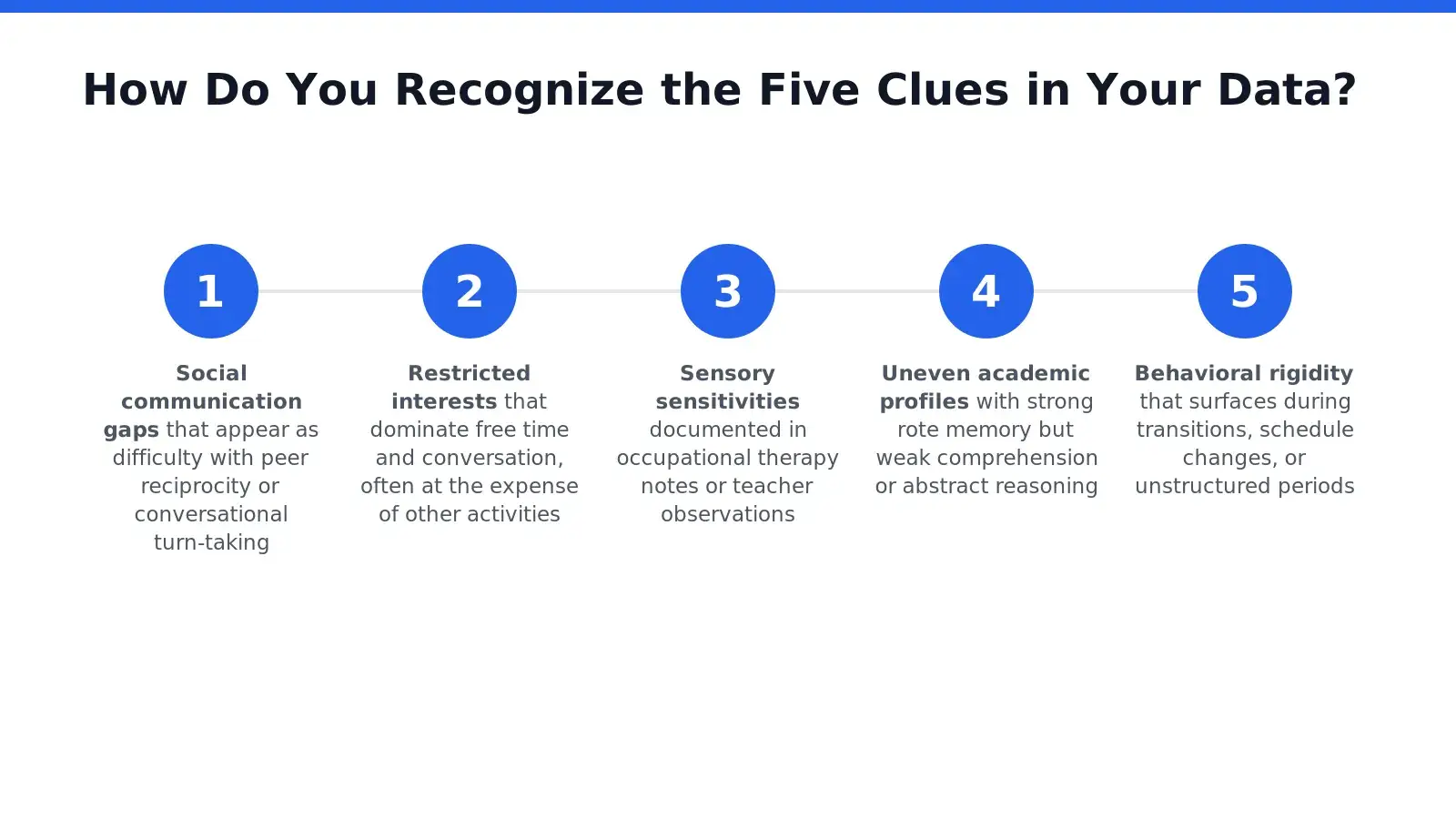
The five clues in school data include:
- Social communication gaps that appear as difficulty with peer reciprocity or conversational turn-taking
- Restricted interests that dominate free time and conversation, often at the expense of other activities
- Sensory sensitivities documented in occupational therapy notes or teacher observations
- Uneven academic profiles with strong rote memory but weak comprehension or abstract reasoning
- Behavioral rigidity that surfaces during transitions, schedule changes, or unstructured periods
Assessing autism in school-age children allows interventions to be implemented that provide strategies for managing classroom and social behaviors. Each clue in the data points toward a more accurate diagnostic path. School psychologists who learn to spot these patterns reduce the risk of overlooking ASD in students who need support.
Which Assessment Tools Work Best for School-Age Autism?
Selecting assessment tools for school-age autism requires instruments that align with current diagnostic criteria and school-based practice. The best practice guide for autism spectrum disorder in schools, updated to reflect DSM-5 standards, provides a framework for choosing tools that support accurate identification and educational planning. School psychologists need measures that translate directly into intervention strategies within the school environment.
What Makes an Assessment Tool School-Ready?
An effective ASD assessment training school psychologists receive emphasizes tools that bridge diagnosis and classroom support. The guide identifies instruments that help professionals recognize risk factors early and conduct case finding within school populations. Tools must produce data that informs individualized education program (IEP) goals and Trauma-Informed MTSS in School Psychology in School Psychologists. The guide supports developing comprehensive educational programs based on assessment results, ensuring that evaluation findings lead to actionable classroom strategies.
How Do Tools Support Evidence-Based Intervention?
The autism diagnostic evaluation in schools process requires instruments that connect directly to evidence-based practices. The guide helps school-based professionals identify interventions that research supports for children and youth on the autism spectrum. Assessment tools should measure skills across multiple domains, including communication, social interaction, and adaptive behavior. This multi-domain approach allows the school psychologist autism assessment guide to recommend targeted interventions that address specific deficits observed during evaluation.
Child & School Psychology Continuing Education offers courses that emphasize practical, evidence-based approaches to assessment. These courses are affordably priced and designed specifically for school psychologists who need training that fits their schedules. The platform provides NASP-approved professional development focused on translating assessment data into effective school-based interventions.
How Do You Conduct a Diagnostic Evaluation in Schools?
A diagnostic evaluation in schools follows a structured, evidence-based process that integrates current research with established best-practice guidelines. School psychologists build the evaluation around screening, assessment, and educational planning for children and youth on the spectrum. This approach ensures every decision traces back to defensible data rather than intuition.
The evaluation process moves through several distinct phases. Each phase builds on the previous one, creating a complete picture of the child’s needs.
- Review existing records. Examine prior assessments, teacher observations, and work samples before meeting the child. This step identifies early risk factors and guides case finding.
- Conduct systematic screening. Use validated screening tools to determine whether a full autism diagnostic evaluation in schools is warranted. Screening flags concerns early, when intervention has the greatest impact.
- Gather multi-informant data. Collect input from parents, teachers, and the child across multiple settings. School-based professionals rely on this triangulated view to distinguish autism from other conditions.
- Administer targeted assessment measures. Select tools that align with current diagnostic criteria and the child’s developmental level. The assessment must capture communication, social interaction, and restricted or repetitive behaviors.
- Integrate findings with theory. Interpret results through the lens of established research. This integration separates a school psychologist autism assessment guide from a simple test battery.
- Develop tailored educational strategies. Translate assessment results into concrete classroom supports, social goals, and behavioral plans.
Why Does Early Identification Matter in Schools?
This proactive approach supports the child’s academic success and promotes emotional well-being. Children build confidence and experience a more positive learning environment when needs are met early.
What Makes an Assessment Accurate?
Accurate assessments lead to tailored educational strategies that empower children to reach their full potential in both school and social settings. The assessment must reflect the child’s real-world functioning, not just performance in a testing room. ASD assessment training school psychologists receive emphasizes this practical, evidence-based connection between data and daily practice.
How Can You Turn Assessment Results Into Interventions?
A school psychologist autism assessment guide must bridge the gap between diagnostic findings and classroom support. By assessing autism in school-age children, professionals can implement interventions that enhance communication and improve peer interactions. The assessment data directly informs strategies for managing classroom and social behaviors.
What Is the First Step After Completing an Autism Diagnostic Evaluation in Schools?
The autism diagnostic evaluation in schools produces a profile of strengths and needs. School psychologists use this profile to select evidence-based interventions that target specific skill deficits. The evaluation results guide decisions about communication supports, social skills training, and behavioral accommodations. Without this structured translation from data to action, assessment reports remain unused documents.
How Do Training Programs Support This Translation Process?
ASD assessment training school psychologists emphasizes the practical application of findings. Child & School Psychology Continuing Education courses include short written application activities where professionals explain how they would use the material in practice. These activities require practitioners to connect assessment results to specific intervention strategies. Interactive questions and learning activities provide quick feedback so professionals can confirm their understanding of assessment and intervention concepts.
A practical approach to turning results into interventions follows these steps:
- Identify priority areas from the assessment data, such as communication deficits or social interaction challenges.
- Select evidence-based strategies that match the child’s developmental level and school setting.
- Write measurable goals that translate assessment findings into observable classroom behaviors.
- Plan progress monitoring methods to track intervention effectiveness over time.
- Document the intervention plan in the individualized education program (IEP) or Special Education Law for School Psychologists: IDEA & 504.
The guide provides a practical and scientifically-based approach to identifying, assessing, and treating children and adolescents with ASD in school settings. School psychologists who complete structured training move from assessment results to actionable intervention plans with greater confidence and precision.
What Training Gaps Hinder School Psychologist ASD Assessment?
School psychologists face rising demands to identify autism spectrum disorder in schools. Many lack targeted training in evidence-based assessment methods. The number of children identified with autism has more than doubled over the last decade, increasing the need for effective screening and assessment by school psychologists. Without specialized preparation, practitioners risk missing critical diagnostic clues during evaluations.
Why do school psychologists miss autism signs during evaluations?
Many school psychologists recall past assessment cases that seemed puzzling at the time, only to realize later that autism was the underlying condition. The call for greater use of evidence-based practice has increased demands that school personnel recognize risk factors and engage in case finding. Without ASD assessment training school psychologists may overlook subtle presentations, particularly in verbally fluent students or those with co-occurring conditions. This gap directly affects the quality of autism diagnostic evaluation in schools.
What specific training areas are most lacking?
Three training gaps consistently hinder accurate identification:
- Recognition of risk factors across developmental stages. Practitioners need training to spot early indicators that persist or evolve as children age.
- Case-finding strategies within school data. Many school psychologists lack systematic methods for reviewing existing records, behavioral observations, and teacher reports for autism markers.
- Integration of evidence-based assessment tools. Without current knowledge of DSM-5-aligned instruments and protocols, evaluations may miss key diagnostic features.
Child & School Psychology Continuing Education addresses these gaps directly. The platform provides NASP-approved professional development designed specifically for school psychologists and child-focused professionals. Courses meet continuing education requirements for NCSPs, LEPs, and school psychologists across different states. This training equips practitioners with a practical school psychologist autism assessment guide grounded in current research and best-practice standards.
Where Can You Find Ongoing ASD Assessment Training That Fits?
School psychologists find ASD assessment training school psychologists trust through NASP-approved home study programs that prioritize practical, evidence-based methods. These programs deliver the autism diagnostic evaluation in schools skills needed without requiring time away from daily caseloads. The training fits around a school calendar, not the other way around.
Busy professionals lose valuable continuing education hours to rigid schedules and generic content. A school psychologist autism assessment guide built on reading-based learning and interactive exercises solves that problem. Learners move through material at their own pace, returning to sections whenever needed. This approach turns professional development into a flexible tool rather than another obligation.
What Makes a School-Based ASD Assessment Program Effective?
Effective programs combine research-based readings with hands-on activities that mirror real school scenarios. Sorting exercises, case-based decision-making, and knowledge checks help professionals apply the autism diagnostic evaluation in schools process immediately. These interactive elements transform passive reading into active skill building.
The best training also includes short written application activities. These prompts ask the professional to explain how they would use the material in practice. This reflection bridges the gap between theory and the classroom, ensuring new strategies stick.
How Do You Choose the Right Training Format?
- Reading-based courses suit professionals who prefer deep, self-paced study
- Interactive activities reinforce learning through sorting, matching, and scenario practice
- Knowledge checks provide immediate feedback on understanding
- Application exercises connect course content to real student cases
What Should a School Psychologist Look For in ASD Training?
Look for programs that acknowledge the realities of school-based practice. The assessment process in schools differs from clinical settings, requiring attention to educational impact, classroom observation, and team collaboration. Training should address these school-specific factors directly.
Award-winning course design signals quality and innovation in online learning. The commitment to accessible, practical training has earned recognition for course quality. This recognition matters because it reflects a proven track record of helping school professionals enhance their skills effectively.
Ongoing training should also support the full assessment journey. From initial case finding to comprehensive evaluation and intervention planning, the right program prepares professionals for every stage. This comprehensive approach ensures no child falls through the cracks due to a missed diagnosis.
Conclusion
In closing, mastering ASD assessment requires school psychologists to integrate evidence-based practices with practical classroom application, a skill set that directly impacts the lives of students and families you serve. Child & School Psychology Continuing Education equips you with the research-based knowledge. Interactive training necessary to refine your assessment competencies at your own pace. By investing in your professional development through NASP-approved coursework, you strengthen your ability to identify, evaluate, and support students with autism spectrum disorder, ultimately advancing your effectiveness as a school psychologist.