

School psychologists fulfill IDEA compliance, manifestation determination, and Section 504 requirements through Child & School Psychology Continuing Education’s NASP-approved courses, which satisfy continuing education standards for NCSPs and LEPs across multiple states while delivering practical, evidence-based training at an affordable price.
Manifestation determination reviews, introduced in IDEA’s 1997 amendments and streamlined under IDEA 2004, require school teams to determine whether disciplinary infractions relate to a student’s disability. Child & School Psychology Continuing Education’s NASP-approved courses train school psychologists in IDEA compliance, MDR procedures, and Section 504 implementation through practical, reading-based learning.
School psychologists navigate IDEA discipline rules, manifestation determination reviews, and Section 504 obligations as core compliance duties on IEP and 504 teams. IDEA 2004 simplified manifestation review requirements after the 1997 amendments introduced them. Child & School Psychology Continuing Education offers NASP-approved, reading-based courses covering these exact NASP-Approved CEU Courses Online in School Psychology Professionals for practicing school psychologists nationwide.
What are the legal foundations for school psychologists?
School psychologists operate within a complex legal framework anchored by the special education law for school psychologists, primarily the Individuals with Disabilities Education Act (IDEA) and Section 504 of the Rehabilitation Act of 1973. These laws mandate specific procedures for evaluation, eligibility, and discipline. IDEA’s discipline procedures require a manifestation determination review guide to determine if a student’s behavior stems from a disability. This process protects students with disabilities from discriminatory discipline practices.
The legal foundations rest on several key statutes and ethical codes. IDEA compliance school psychology requires adherence to federal regulations. State codes, such as the california education code special education discipline provisions, add specific requirements. Understanding the distinction between Section 504 vs IDEA school psychologists is critical. 504 plans offer broader protections for students who do not qualify for special education. The [School Psychology Email Confidentiality Statements: FERPA & Ethics](https://childschoolpsychologyce.com/school-psychology-email-confidentiality-statements-ferpa-ethics/) courses ensure practitioners stay current with these evolving standards.
How do the legal foundations apply in practice?
- Manifestation Determination Review (MDR): This review determines if a child’s behavior is linked to their disability. The manifestation determination meeting protocol requires a team to review all relevant information.
- Section 504: This law provides a district implementation guide for compliance, ensuring students with disabilities receive appropriate accommodations.
- IDEA: This law mandates a free appropriate public education (FAPE) and includes specific discipline procedures for students with disabilities.
What is the role of the school psychologist in these legal processes?
School psychologists serve as key members of the IEP and 504 teams. They provide crucial insights into a student’s disability and its relationship to behavior. Their expertise is essential for conducting legally sound manifestation determination reviews. Ensuring that discipline decisions do not discriminate against students with disabilities. This role requires a deep understanding of both federal law and state regulations.
How do you conduct a manifestation determination review?
A manifestation determination review (MDR) is a formal hearing the school must hold when proposing to remove a child with a disability for violating the code of conduct. The team reviews all relevant information to decide whether the child’s behavior was caused by their disability. This process protects students from discriminatory discipline.
What is the purpose of an MDR?
The core question in any manifestation determination review guide is whether the behavior directly relates to the disability. The team examines the relationship between the child’s disability and the specific conduct. Consequences for problem behaviors should not discriminate against a child based on their disability. Yet, schools continue to suspend and expel students with disabilities for behavior caused by their disability, which is why this review is essential for IDEA compliance school psychology.
What are the steps in an MDR meeting?
The manifestation determination meeting protocol follows a structured sequence. School psychologists play a key role in presenting data and analysis.
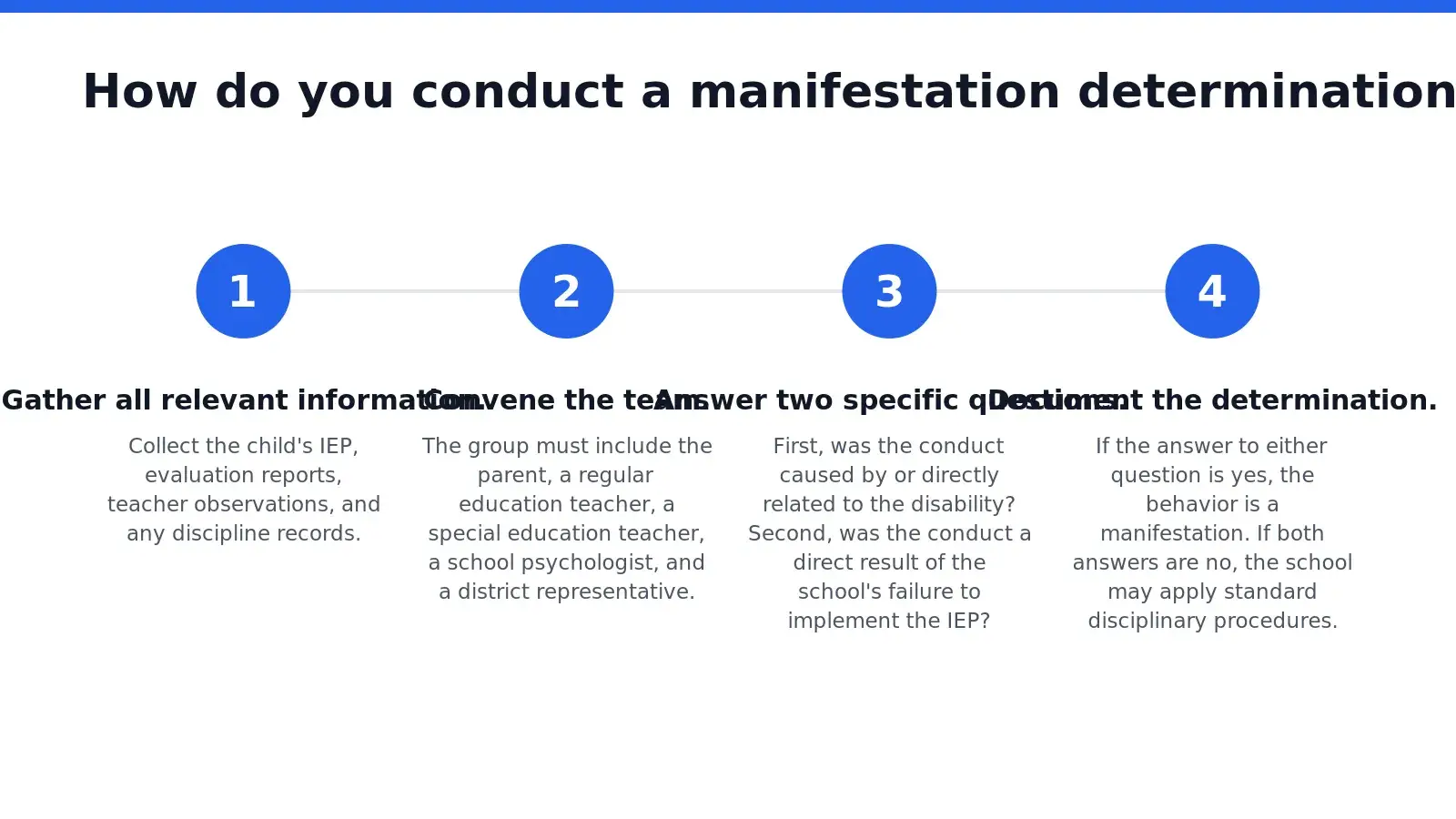
- Gather all relevant information. Collect the child’s IEP, evaluation reports, teacher observations, and any discipline records.
- Convene the team. The group must include the parent, a regular education teacher, a special education teacher, a school psychologist, and a district representative.
- Answer two specific questions. First, was the conduct caused by or directly related to the disability? Second, was the conduct a direct result of the school’s failure to implement the IEP?
- Document the determination. If the answer to either question is yes, the behavior is a manifestation. If both answers are no, the school may apply standard disciplinary procedures.
What happens when the behavior is a manifestation?
When the team determines the behavior is a manifestation, the school cannot change the child’s placement without parental agreement. The IEP team must then conduct a functional behavioral assessment (FBA) and develop a behavior intervention plan (BIP). If a BIP already exists, the team must review and revise it to address the behavior. This process aligns with NASP ethics special education legal CE standards by ensuring fair treatment and procedural safeguards.

What are common mistakes in IDEA and Section 504 compliance?
School psychologists frequently encounter compliance errors that carry serious consequences for students with disabilities. One recurring mistake involves misunderstanding when a manifestation determination review guide is required under IDEA. Manifestation determinations were first introduced into IDEA with the 1997 amendments, and the process was simplified under IDEA 2004. Many school teams incorrectly assume a manifestation determination is needed for every disciplinary removal, regardless of duration.
When is a manifestation determination actually required?
IDEA 2004 limits the requirement for a manifestation determination to removals that constitute a change of placement under IDEA’s disciplinary procedures. A common compliance error is misunderstanding when a full review is required for removals that do not meet the change of placement threshold. The law does not require a manifestation determination for removals of less than 10 consecutive school days that do not constitute a change in placement. School psychologists who apply the 10-day rule inconsistently risk procedural violations.
How do Section 504 and IDEA compliance differ?
Another frequent mistake involves confusing Section 504 vs IDEA school psychologists must navigate. Section 504 protections apply to a broader population of students. IDEA provides specific procedural safeguards for students who qualify under one of 13 disability categories. School psychologists who apply IDEA’s manifestation determination standard to all 504-only students create compliance gaps. Understanding the distinction between these two federal laws is essential for IDEA compliance school psychology practice.
What role does state law play in discipline procedures?
State regulations add another layer of complexity. For example, California education code special education discipline requirements may exceed federal minimums, mandating manifestation determinations for removals that would not trigger one under IDEA alone. School psychologists practicing in California must know both federal and state obligations to avoid compliance errors. Child & School Psychology CE offers courses that meet Affordable NASP CEUs for NCSPs: Compliance & CPD Renewal requirements for NCSPs, LEPs, and school psychologists in different states, helping practitioners stay current on these legal nuances.
Common compliance mistakes at a glance
How can school psychologists avoid these errors?
Following a structured manifestation determination meeting protocol reduces the risk of oversight. School teams should verify that the removal meets the change-of-placement threshold before convening an MDR. Documenting each step of the review process, including the rationale for findings, protects both the student and the district. Pursuing NASP ethics special education legal CE ensures practitioners understand the ethical obligations that accompany legal compliance.
Conclusion
In closing, mastering IDEA compliance, manifestation determination, and Section 504 protections represents essential knowledge for school psychologists navigating today’s complex special education landscape. Child & School Psychology Continuing Education equips you with the research-based, practical training needed to apply these legal frameworks confidently in your daily work. Our NASP-approved courses break down these critical topics through engaging readings. Interactive exercises, allowing you to strengthen your expertise at your own pace while meeting your professional development requirements.