
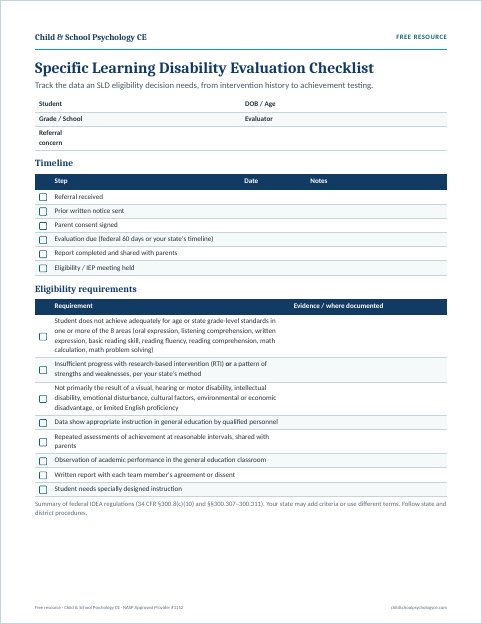
Specific Learning Disability Evaluation Checklist
Track the data an SLD eligibility decision needs, from intervention history to achievement testing. A free, fillable checklist for school psychologists and evaluation teams.
What’s inside
- The federal eligibility requirements, each with space to note where the evidence is documented
- 23 commonly used measures to check off, with date tested, examiner and results
- Records, interviews, observations and screenings
- Exclusionary factors ruled out
- Evaluation timeline and a team summary box
Get it free
Enter your email and confirm it. You’ll go straight to the download, plus all our other free checklists and tools.
What IDEA requires for Specific Learning Disability
The checklist walks your team through each part of the federal definition so nothing is missed at the eligibility meeting:
- Student does not achieve adequately for age or state grade-level standards in one or more of the 8 areas (oral expression, listening comprehension, written expression, basic reading skill, reading fluency, reading comprehension, math calculation, math problem solving)
- Insufficient progress with research-based intervention (RTI) or a pattern of strengths and weaknesses, per your state’s method
- Not primarily the result of a visual, hearing or motor disability, intellectual disability, emotional disturbance, cultural factors, environmental or economic disadvantage, or limited English proficiency
- Data show appropriate instruction in general education by qualified personnel
- Repeated assessments of achievement at reasonable intervals, shared with parents
- Observation of academic performance in the general education classroom
- Written report with each team member’s agreement or dissent
- Student needs specially designed instruction
Summary of federal IDEA regulations (34 CFR §300.8(c)(10) and §§300.307–300.311). Your state may add criteria or use different terms. Follow state and district procedures.
Measures included in the checklist
No single test determines eligibility. The checklist lists measures school psychologists commonly use so you can document what was given, when and by whom:
- Cognitive / intellectual: WISC-V, WJ IV or WJ V Tests of Cognitive Abilities, KABC-II NU, DAS-II, CAS2, RIAS-2
- Achievement: WIAT-4, KTEA-3, WJ IV or WJ V Tests of Achievement
- Reading: CTOPP-2 (phonological processing), TOWRE-2 (word reading efficiency), GORT-5 (oral reading), FAR (Feifer Assessment of Reading)
- Math and writing: KeyMath-3, FAM (Feifer Assessment of Mathematics), TOWL-4 (written language)
- Memory and processing: WRAML3, Beery VMI, NEPSY-II (selected subtests)
- Progress monitoring and other: Curriculum-based measures: reading, Curriculum-based measures: math / writing, State and district assessment results, Speech-language evaluation (if language concerns)
Blank rows let you add any other measures your team uses.
Exclusionary factors ruled out
- Vision, hearing or motor disability
- Intellectual disability or emotional disturbance
- Cultural factors
- Environmental or economic disadvantage
- Limited English proficiency
- Lack of appropriate instruction in reading or math
Frequently asked questions
Is the checklist fillable?
Yes. You can type into it on a computer or print it. Check boxes are printed, and every date, examiner and notes field can be filled in digitally.
Does this replace my state or district forms?
No. It is a working checklist to organize data. Your state may add criteria or use different terms, so always follow state and district procedures and use their required forms.
Can I share it with my evaluation team?
Yes. Share it with colleagues on your team. If others want their own copy, send them to this page.