
ADHD Evaluation Checklist
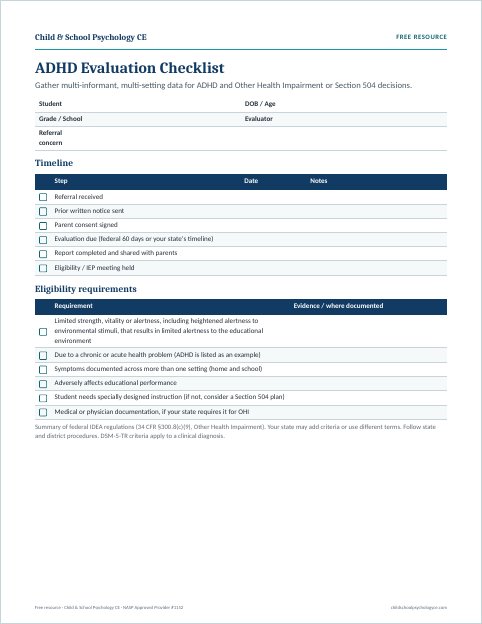
Gather multi-informant, multi-setting data for ADHD and Other Health Impairment or Section 504 decisions. A free, fillable checklist for school psychologists and evaluation teams.
What’s inside
- The federal eligibility requirements, each with space to note where the evidence is documented
- 18 commonly used measures to check off, with date tested, examiner and results
- Records, interviews, observations and screenings
- Rule-outs and other explanations considered
- Evaluation timeline and a team summary box
Get it free
Enter your email and confirm it. You’ll go straight to the download, plus all our other free checklists and tools.
What IDEA requires for ADHD
The checklist walks your team through each part of the federal definition so nothing is missed at the eligibility meeting:
- Limited strength, vitality or alertness, including heightened alertness to environmental stimuli, that results in limited alertness to the educational environment
- Due to a chronic or acute health problem (ADHD is listed as an example)
- Symptoms documented across more than one setting (home and school)
- Adversely affects educational performance
- Student needs specially designed instruction (if not, consider a Section 504 plan)
- Medical or physician documentation, if your state requires it for OHI
Summary of federal IDEA regulations (34 CFR §300.8(c)(9), Other Health Impairment). Your state may add criteria or use different terms. Follow state and district procedures. DSM-5-TR criteria apply to a clinical diagnosis.
Measures included in the checklist
No single test determines eligibility. The checklist lists measures school psychologists commonly use so you can document what was given, when and by whom:
- Rating scales: parent: Conners 4 (parent), BASC-3 PRS, Vanderbilt (parent), ADHD-5 Rating Scale (home), BRIEF2 (parent)
- Rating scales: teachers (2+ if possible): Conners 4 (teacher 1), Conners 4 or BASC-3 TRS (teacher 2), Vanderbilt (teacher), BRIEF2 (teacher)
- Self-report (older students): Conners 4 (self), BASC-3 SRP, BRIEF2 (self)
- Performance and screening: Conners CPT 3 (optional), Cognitive screen (e.g., WISC-V working memory and processing speed), Achievement screen (e.g., WIAT-4 or KTEA-3)
- Observations: Classroom observation: structured instruction, Classroom observation: independent work, Observation: less structured setting
Blank rows let you add any other measures your team uses.
Rule-outs and other explanations considered
- Vision or hearing problems
- Sleep problems
- Anxiety or depression
- Trauma or major life stressors
- Learning disability or language disorder
- Medical conditions or medication side effects
Frequently asked questions
Is the checklist fillable?
Yes. You can type into it on a computer or print it. Check boxes are printed, and every date, examiner and notes field can be filled in digitally.
Does this replace my state or district forms?
No. It is a working checklist to organize data. Your state may add criteria or use different terms, so always follow state and district procedures and use their required forms.
Can I share it with my evaluation team?
Yes. Share it with colleagues on your team. If others want their own copy, send them to this page.