
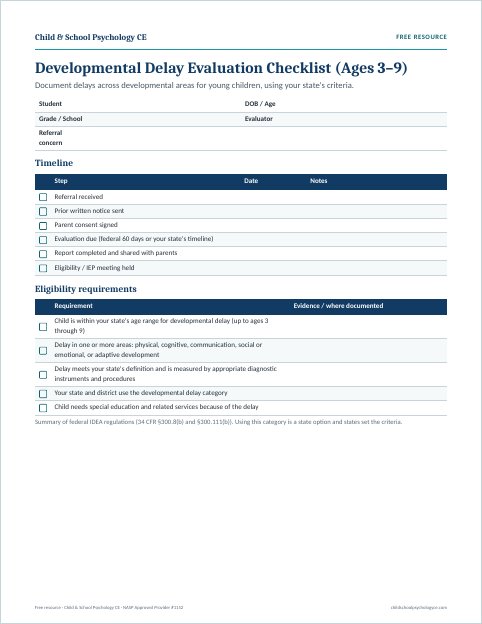
Developmental Delay Evaluation Checklist (Ages 3–9)
Document delays across developmental areas for young children, using your state’s criteria. A free, fillable checklist for school psychologists and evaluation teams.
What’s inside
- The federal eligibility requirements, each with space to note where the evidence is documented
- 16 commonly used measures to check off, with date tested, examiner and results
- Records, interviews, observations and screenings
- Other considerations
- Evaluation timeline and a team summary box
Get it free
Enter your email and confirm it. You’ll go straight to the download, plus all our other free checklists and tools.
What IDEA requires for Developmental Delay
The checklist walks your team through each part of the federal definition so nothing is missed at the eligibility meeting:
- Child is within your state’s age range for developmental delay (up to ages 3 through 9)
- Delay in one or more areas: physical, cognitive, communication, social or emotional, or adaptive development
- Delay meets your state’s definition and is measured by appropriate diagnostic instruments and procedures
- Your state and district use the developmental delay category
- Child needs special education and related services because of the delay
Summary of federal IDEA regulations (34 CFR §300.8(b) and §300.111(b)). Using this category is a state option and states set the criteria.
Measures included in the checklist
No single test determines eligibility. The checklist lists measures school psychologists commonly use so you can document what was given, when and by whom:
- Comprehensive developmental: BDI-3 (Battelle Developmental Inventory), DAYC-2, Bayley-4 (under 42 months), Play-based assessment
- Cognitive: WPPSI-IV, DAS-II (early years)
- Communication: PLS-5, CELF Preschool-3, Speech-language evaluation
- Motor: PDMS (Peabody Developmental Motor Scales), Occupational / physical therapy evaluation
- Social-emotional and adaptive: BASC-3 Preschool (parent / teacher), DECA-P2, Vineland-3, ABAS-3, Observation in preschool or home setting
Blank rows let you add any other measures your team uses.
Other considerations
- Early intervention (Part C) records and transition
- Vision and hearing screened
- Home language and cultural factors
- Prematurity or medical history
- Parent priorities
- Plan for re-evaluation before the age limit
Frequently asked questions
Is the checklist fillable?
Yes. You can type into it on a computer or print it. Check boxes are printed, and every date, examiner and notes field can be filled in digitally.
Does this replace my state or district forms?
No. It is a working checklist to organize data. Your state may add criteria or use different terms, so always follow state and district procedures and use their required forms.
Can I share it with my evaluation team?
Yes. Share it with colleagues on your team. If others want their own copy, send them to this page.