
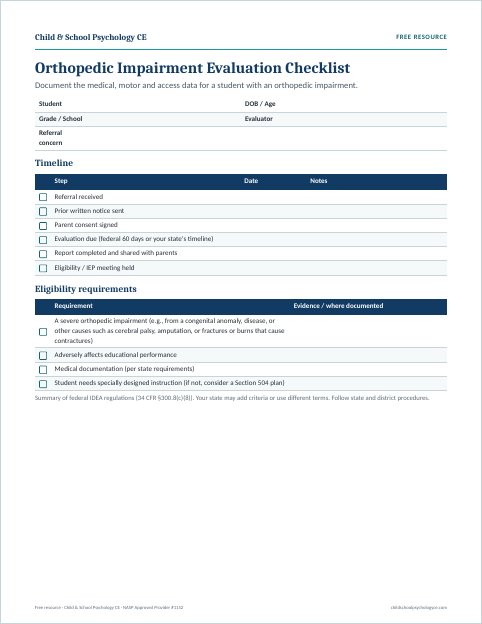
Orthopedic Impairment Evaluation Checklist
Document the medical, motor and access data for a student with an orthopedic impairment. A free, fillable checklist for school psychologists and evaluation teams.
What’s inside
- The federal eligibility requirements, each with space to note where the evidence is documented
- 12 commonly used measures to check off, with date tested, examiner and results
- Records, interviews, observations and screenings
- Planning considerations
- Evaluation timeline and a team summary box
Get it free
Enter your email and confirm it. You’ll go straight to the download, plus all our other free checklists and tools.
What IDEA requires for Orthopedic Impairment
The checklist walks your team through each part of the federal definition so nothing is missed at the eligibility meeting:
- A severe orthopedic impairment (e.g., from a congenital anomaly, disease, or other causes such as cerebral palsy, amputation, or fractures or burns that cause contractures)
- Adversely affects educational performance
- Medical documentation (per state requirements)
- Student needs specially designed instruction (if not, consider a Section 504 plan)
Summary of federal IDEA regulations (34 CFR §300.8(c)(8)). Your state may add criteria or use different terms. Follow state and district procedures.
Measures included in the checklist
No single test determines eligibility. The checklist lists measures school psychologists commonly use so you can document what was given, when and by whom:
- Medical and motor: Medical records (with consent), Physical therapy evaluation, Occupational therapy evaluation, Seating, positioning and mobility review
- Access and technology: Assistive technology evaluation, Physical access to school, classroom and materials
- Cognitive and achievement: Motor-reduced cognitive measure, with accommodations, Achievement measure, with accommodations, Work completion and writing speed
- Adaptive and social-emotional: Adaptive measure (Vineland-3 or ABAS-3), BASC-3 or social-emotional rating, Observation across settings
Blank rows let you add any other measures your team uses.
Planning considerations
- Health care plan and emergency plan
- Personal care needs
- Transportation needs
- Fatigue and pacing
- Participation in physical education
- Evacuation and safety plan
Frequently asked questions
Is the checklist fillable?
Yes. You can type into it on a computer or print it. Check boxes are printed, and every date, examiner and notes field can be filled in digitally.
Does this replace my state or district forms?
No. It is a working checklist to organize data. Your state may add criteria or use different terms, so always follow state and district procedures and use their required forms.
Can I share it with my evaluation team?
Yes. Share it with colleagues on your team. If others want their own copy, send them to this page.