
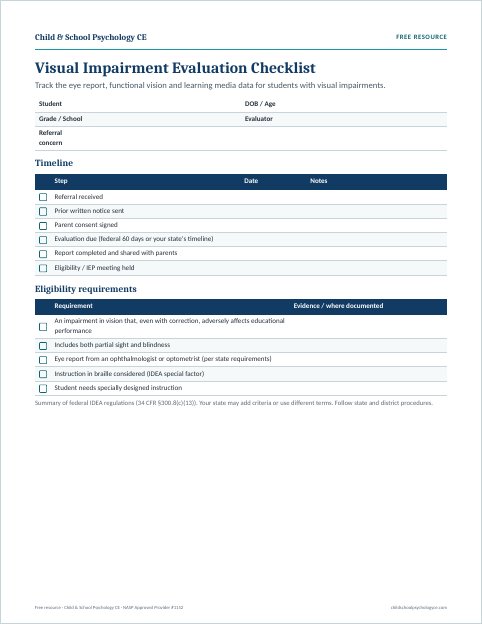
Visual Impairment Evaluation Checklist
Track the eye report, functional vision and learning media data for students with visual impairments. A free, fillable checklist for school psychologists and evaluation teams.
What’s inside
- The federal eligibility requirements, each with space to note where the evidence is documented
- 11 commonly used measures to check off, with date tested, examiner and results
- Records, interviews, observations and screenings
- Access considerations
- Evaluation timeline and a team summary box
Get it free
Enter your email and confirm it. You’ll go straight to the download, plus all our other free checklists and tools.
What IDEA requires for Visual Impairment
The checklist walks your team through each part of the federal definition so nothing is missed at the eligibility meeting:
- An impairment in vision that, even with correction, adversely affects educational performance
- Includes both partial sight and blindness
- Eye report from an ophthalmologist or optometrist (per state requirements)
- Instruction in braille considered (IDEA special factor)
- Student needs specially designed instruction
Summary of federal IDEA regulations (34 CFR §300.8(c)(13)). Your state may add criteria or use different terms. Follow state and district procedures.
Measures included in the checklist
No single test determines eligibility. The checklist lists measures school psychologists commonly use so you can document what was given, when and by whom:
- Vision: Eye report (ophthalmologist / optometrist), Functional vision assessment (FVA), Learning media assessment (LMA), Orientation and mobility evaluation
- Cognitive and achievement (with accommodations): Verbal cognitive measures with adaptations (e.g., WISC-V verbal scales), Achievement measure in large print or braille, Reading speed and stamina
- Other: Assistive technology evaluation, Expanded core curriculum needs, Adaptive / independent living skills, Classroom observation (lighting, materials, mobility)
Blank rows let you add any other measures your team uses.
Access considerations
- Print size, braille or audio format
- Lighting and contrast
- Assistive technology and devices
- Safe travel and mobility
- Social skills and peer interaction
- Teacher of students with visual impairments involved
Frequently asked questions
Is the checklist fillable?
Yes. You can type into it on a computer or print it. Check boxes are printed, and every date, examiner and notes field can be filled in digitally.
Does this replace my state or district forms?
No. It is a working checklist to organize data. Your state may add criteria or use different terms, so always follow state and district procedures and use their required forms.
Can I share it with my evaluation team?
Yes. Share it with colleagues on your team. If others want their own copy, send them to this page.